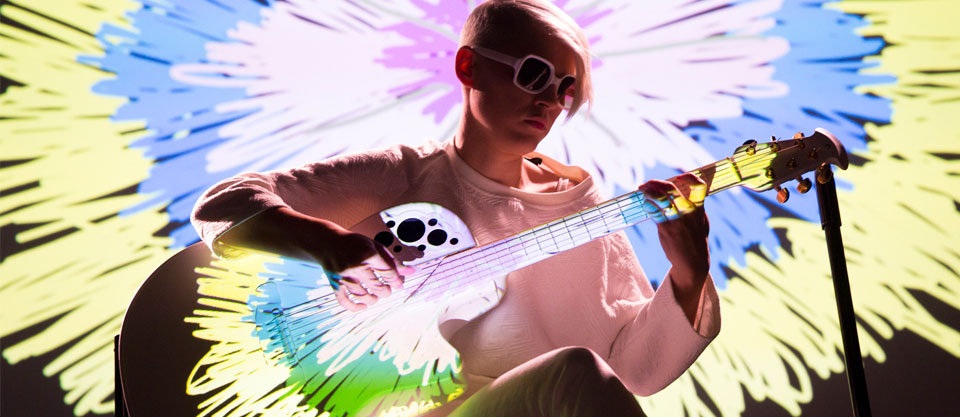
Known as one of the greatest guitar innovators of our time, Kaki King presents MODERN YESTERDAYS, a refinement of her now signature guitar-projection mapping performance. With technicolor imagination, technical wizardry, and carefully choreographed guitar and drum playing, "she'll do the unexpected, every time" (Digital Trends). Bridging future-forward modernity with contemplative longing, MODERN YESTERDAYS sends us on an audiovisual journey reset by our recent past, arriving at the emotional place we yearn to visit.
The album Modern Yesterdays (released in late 2020 on Cantaloupe Music) derives broadly from the music composed for Data Not Found (DNF), Kaki King's largest-scale and most theatrical performance piece yet. With the post-pandemic performance world ever-evolving, Kaki King set out to create an analog to Data Not Found, which can now be found in MODERN YESTERDAYS: an interlocking puzzle piece nimble enough to tour the world in 2021, and beyond.
~~~~~~~~
Hailed by Rolling Stone as "a genre unto herself," Brooklyn-based composer and guitarist Kaki King has released 9 albums over the past 14 years. She has performed on every continent over the course of multiple world tours, and has presented her work in a variety of prestigious arts centers, including the Kennedy Center, MoMA, LACMA and The Met. Kaki has created music for numerous film and TV soundtracks, including "August Rush" and Sean Penn's "Into the Wild", for which received a Golden Globe nomination for Best Original Score.
In 2015 Kaki launched "The Neck is a Bridge to the Body", a groundbreaking multi-media performance that uses projection mapping to turn her guitar into a projection screen depicting a wildly luminous creation myth. King also recently recorded her first full-length album with symphony orchestra, commissioned by the Berklee College of Music, which was released in 2017. Most recently she has added album producer and record label owner to her credits with the announcement of Treya Lam's debut album Good News, released in June 2018.
show less
The album Modern Yesterdays (released in late 2020 on Cantaloupe Music) derives broadly from the music composed for Data Not Found (DNF), Kaki King's largest-scale and most theatrical performance piece yet. With the post-pandemic performance world ever-evolving, Kaki King set out to create an analog to Data Not Found, which can now be found in MODERN YESTERDAYS: an interlocking puzzle piece nimble enough to tour the world in 2021, and beyond.
~~~~~~~~
Hailed by Rolling Stone as "a genre unto herself," Brooklyn-based composer and guitarist Kaki King has released 9 albums over the past 14 years. She has performed on every continent over the course of multiple world tours, and has presented her work in a variety of prestigious arts centers, including the Kennedy Center, MoMA, LACMA and The Met. Kaki has created music for numerous film and TV soundtracks, including "August Rush" and Sean Penn's "Into the Wild", for which received a Golden Globe nomination for Best Original Score.
In 2015 Kaki launched "The Neck is a Bridge to the Body", a groundbreaking multi-media performance that uses projection mapping to turn her guitar into a projection screen depicting a wildly luminous creation myth. King also recently recorded her first full-length album with symphony orchestra, commissioned by the Berklee College of Music, which was released in 2017. Most recently she has added album producer and record label owner to her credits with the announcement of Treya Lam's debut album Good News, released in June 2018.
Known as one of the greatest guitar innovators of our time, Kaki King presents MODERN YESTERDAYS, a refinement of her now signature guitar-projection mapping performance. With technicolor imagination, technical wizardry, and carefully choreographed guitar and drum playing, "she'll do the unexpected, every time" (Digital Trends). Bridging future-forward modernity with contemplative longing, MODERN YESTERDAYS sends us on an audiovisual journey reset by our recent past, arriving at the emotional place we yearn to visit.
The album Modern Yesterdays (released in late 2020 on Cantaloupe Music) derives broadly from the music composed for Data Not Found (DNF), Kaki King's largest-scale and most theatrical performance piece yet. With the post-pandemic performance world ever-evolving, Kaki King set out to create an analog to Data Not Found, which can now be found in MODERN YESTERDAYS: an interlocking puzzle piece nimble enough to tour the world in 2021, and beyond.
~~~~~~~~
Hailed by Rolling Stone as "a genre unto herself," Brooklyn-based composer and guitarist Kaki King has released 9 albums over the past 14 years. She has performed on every continent over the course of multiple world tours, and has presented her work in a variety of prestigious arts centers, including the Kennedy Center, MoMA, LACMA and The Met. Kaki has created music for numerous film and TV soundtracks, including "August Rush" and Sean Penn's "Into the Wild", for which received a Golden Globe nomination for Best Original Score.
In 2015 Kaki launched "The Neck is a Bridge to the Body", a groundbreaking multi-media performance that uses projection mapping to turn her guitar into a projection screen depicting a wildly luminous creation myth. King also recently recorded her first full-length album with symphony orchestra, commissioned by the Berklee College of Music, which was released in 2017. Most recently she has added album producer and record label owner to her credits with the announcement of Treya Lam's debut album Good News, released in June 2018.
read more
The album Modern Yesterdays (released in late 2020 on Cantaloupe Music) derives broadly from the music composed for Data Not Found (DNF), Kaki King's largest-scale and most theatrical performance piece yet. With the post-pandemic performance world ever-evolving, Kaki King set out to create an analog to Data Not Found, which can now be found in MODERN YESTERDAYS: an interlocking puzzle piece nimble enough to tour the world in 2021, and beyond.
~~~~~~~~
Hailed by Rolling Stone as "a genre unto herself," Brooklyn-based composer and guitarist Kaki King has released 9 albums over the past 14 years. She has performed on every continent over the course of multiple world tours, and has presented her work in a variety of prestigious arts centers, including the Kennedy Center, MoMA, LACMA and The Met. Kaki has created music for numerous film and TV soundtracks, including "August Rush" and Sean Penn's "Into the Wild", for which received a Golden Globe nomination for Best Original Score.
In 2015 Kaki launched "The Neck is a Bridge to the Body", a groundbreaking multi-media performance that uses projection mapping to turn her guitar into a projection screen depicting a wildly luminous creation myth. King also recently recorded her first full-length album with symphony orchestra, commissioned by the Berklee College of Music, which was released in 2017. Most recently she has added album producer and record label owner to her credits with the announcement of Treya Lam's debut album Good News, released in June 2018.
show less
Date/Times:
The Best Events
Every Week in Your Inbox

From Our Sponsors
UPCOMING EVENTS







Great suggestion! We'll be in touch.
Event reviewed successfully.