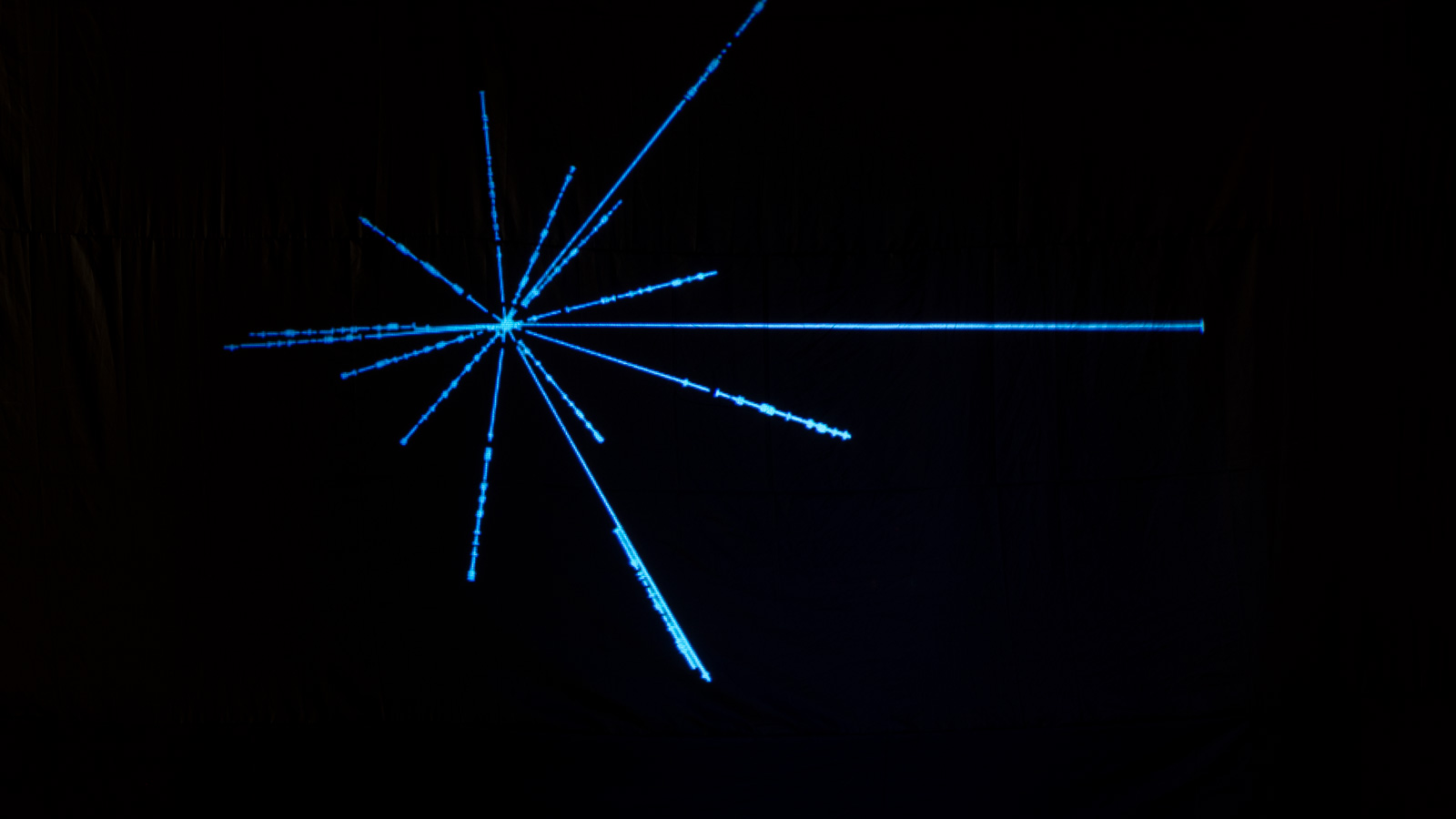
Jitish Kallat's installation Covering Letter (Terranum Nuncius) engages with sounds and images launched into space in 1977 as a cosmic greeting from humanity. Encoded in the Golden Records (gold-plated phonograph LPs) carried by NASA's Voyager 1 and 2 and now traveling over 13 billion miles away, these messages were conceived as a "time capsule" meant to last beyond the potential extinction of our species and planet, as well as an introduction to humanity and life on Earth for potential extraterrestrial recipients.
As the sound of greetings in 55 languages permeates the gallery, diverse backlit images pulse slowly, including scientific diagrams, representations of flora and fauna, and depictions of human anatomy and genetic makeup. These 116 visuals, originally encoded as audio signals on the Golden Records, were later converted back into images by U.S.-based engineer Ron Barry, imagining how they might appear to extraterrestrial viewers. A video projection of the Pulsar Map, derived from the cover of the Golden Record, maps the location of our solar system in the galaxy as a kind of cosmic return address.
"In an embattled and accelerated world, Covering Letter (Terranum Nuncius) offers a chance to think about the passage of time at a different scale," says exhibition curator and Malavalli Family Foundation Associate Curator of the Art of the Indian Subcontinent Padma Dorje Maitland, "as well as an opportunity to reflect on humanity's common ground."
Image Credit: Covering Letter (Terranum Nuncius) (2018-2021), detail and installation view. 116 stereoscopic parallax prints on Plexiglas, programmed LED panels, frames, wooden shelves and bench, 4 horn speakers, video projection. Image courtesy of the artist and Ishara Art Foundation. Photography by Ismail Noor / Seeing Things.
show less
As the sound of greetings in 55 languages permeates the gallery, diverse backlit images pulse slowly, including scientific diagrams, representations of flora and fauna, and depictions of human anatomy and genetic makeup. These 116 visuals, originally encoded as audio signals on the Golden Records, were later converted back into images by U.S.-based engineer Ron Barry, imagining how they might appear to extraterrestrial viewers. A video projection of the Pulsar Map, derived from the cover of the Golden Record, maps the location of our solar system in the galaxy as a kind of cosmic return address.
"In an embattled and accelerated world, Covering Letter (Terranum Nuncius) offers a chance to think about the passage of time at a different scale," says exhibition curator and Malavalli Family Foundation Associate Curator of the Art of the Indian Subcontinent Padma Dorje Maitland, "as well as an opportunity to reflect on humanity's common ground."
Image Credit: Covering Letter (Terranum Nuncius) (2018-2021), detail and installation view. 116 stereoscopic parallax prints on Plexiglas, programmed LED panels, frames, wooden shelves and bench, 4 horn speakers, video projection. Image courtesy of the artist and Ishara Art Foundation. Photography by Ismail Noor / Seeing Things.
Jitish Kallat's installation Covering Letter (Terranum Nuncius) engages with sounds and images launched into space in 1977 as a cosmic greeting from humanity. Encoded in the Golden Records (gold-plated phonograph LPs) carried by NASA's Voyager 1 and 2 and now traveling over 13 billion miles away, these messages were conceived as a "time capsule" meant to last beyond the potential extinction of our species and planet, as well as an introduction to humanity and life on Earth for potential extraterrestrial recipients.
As the sound of greetings in 55 languages permeates the gallery, diverse backlit images pulse slowly, including scientific diagrams, representations of flora and fauna, and depictions of human anatomy and genetic makeup. These 116 visuals, originally encoded as audio signals on the Golden Records, were later converted back into images by U.S.-based engineer Ron Barry, imagining how they might appear to extraterrestrial viewers. A video projection of the Pulsar Map, derived from the cover of the Golden Record, maps the location of our solar system in the galaxy as a kind of cosmic return address.
"In an embattled and accelerated world, Covering Letter (Terranum Nuncius) offers a chance to think about the passage of time at a different scale," says exhibition curator and Malavalli Family Foundation Associate Curator of the Art of the Indian Subcontinent Padma Dorje Maitland, "as well as an opportunity to reflect on humanity's common ground."
Image Credit: Covering Letter (Terranum Nuncius) (2018-2021), detail and installation view. 116 stereoscopic parallax prints on Plexiglas, programmed LED panels, frames, wooden shelves and bench, 4 horn speakers, video projection. Image courtesy of the artist and Ishara Art Foundation. Photography by Ismail Noor / Seeing Things.
read more
As the sound of greetings in 55 languages permeates the gallery, diverse backlit images pulse slowly, including scientific diagrams, representations of flora and fauna, and depictions of human anatomy and genetic makeup. These 116 visuals, originally encoded as audio signals on the Golden Records, were later converted back into images by U.S.-based engineer Ron Barry, imagining how they might appear to extraterrestrial viewers. A video projection of the Pulsar Map, derived from the cover of the Golden Record, maps the location of our solar system in the galaxy as a kind of cosmic return address.
"In an embattled and accelerated world, Covering Letter (Terranum Nuncius) offers a chance to think about the passage of time at a different scale," says exhibition curator and Malavalli Family Foundation Associate Curator of the Art of the Indian Subcontinent Padma Dorje Maitland, "as well as an opportunity to reflect on humanity's common ground."
Image Credit: Covering Letter (Terranum Nuncius) (2018-2021), detail and installation view. 116 stereoscopic parallax prints on Plexiglas, programmed LED panels, frames, wooden shelves and bench, 4 horn speakers, video projection. Image courtesy of the artist and Ishara Art Foundation. Photography by Ismail Noor / Seeing Things.
show less
Date/Times:
The Best Events
Every Week in Your Inbox

From Our Sponsors
UPCOMING EVENTS








Great suggestion! We'll be in touch.
Event reviewed successfully.