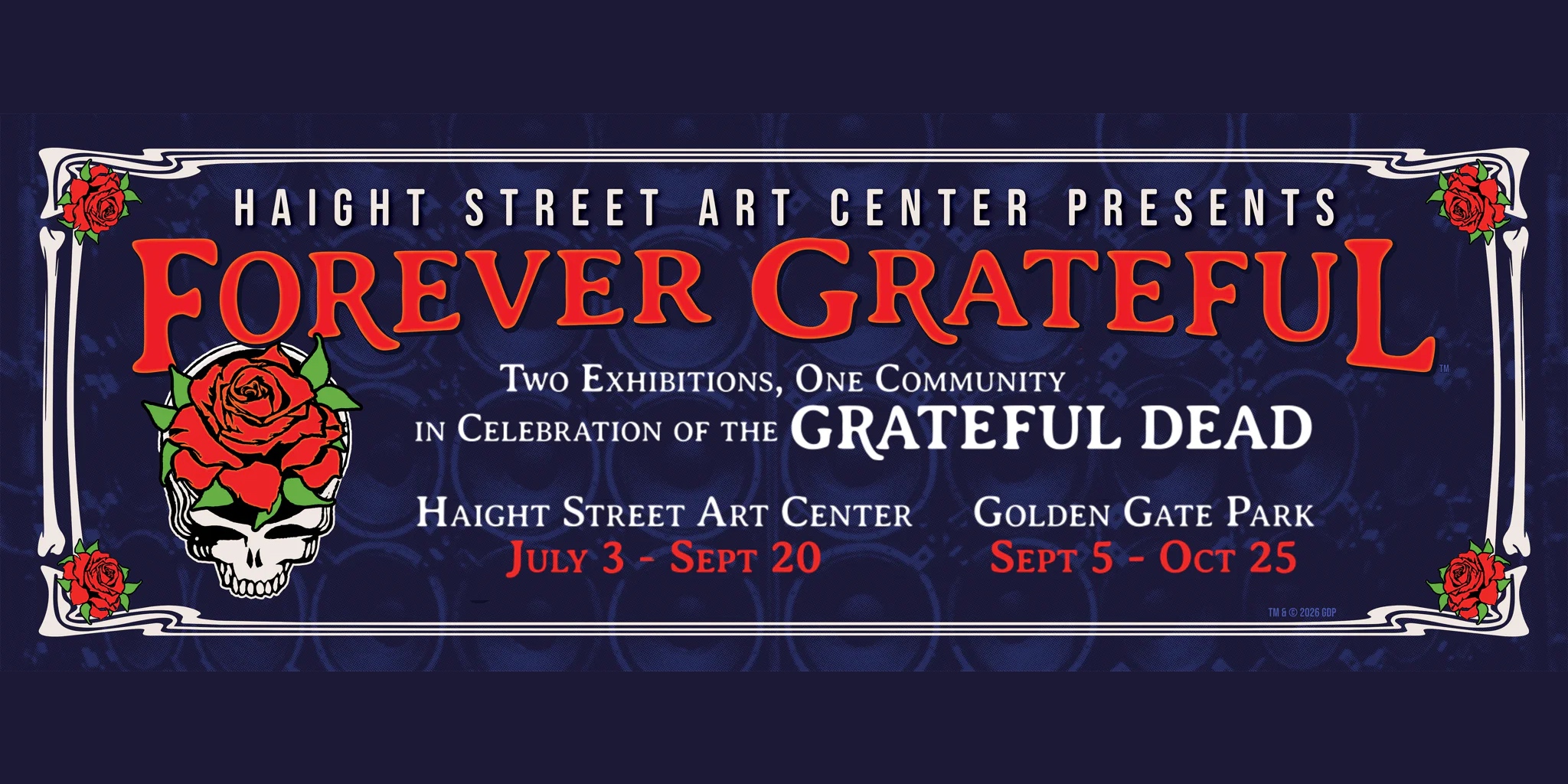
The Haight Street Art Center is proud to present Forever Grateful, a landmark exhibition that pays tribute to the timeless legacy of the Grateful Dead. Opening July 3rd - September 20th, and celebrating the Center's 10th anniversary, this exhibit, featuring an unparalleled collection of artworks, instruments, and memorabilia, invites visitors to explore three decades of the band's groundbreaking history.
Forever Grateful, Golden Gate Park will transform the County Fair Building in Golden Gate Park into an immersive celebration of the music, art, and community that made the Grateful Dead a defining part of San Francisco's cultural identity. The exhibition will open September 5th, kicking off with a free concert on Labor Day Weekend from Grahame Lesh and Friends, the group headed by the son of Grateful Dead founding member Phil Lesh. Forever Grateful will remain on view until October 25th.
~~~
Chronicling the legendary journey of the Grateful Dead from 1965 to 1995, Forever Grateful offers Dead Heads, casual fans, and art lovers an extraordinary glimpse into the magic behind the music and the artistry that became synonymous with the band's cultural impact. Spanning both floors of the Center, the exhibition includes more than 400 works, including paintings, pen and ink drawings, original lithographs used to create visually stunning posters, photographs, vinyl records, instruments, and rare ephemera, tracing the evolution of one of the most influential and enduring forces in the music and ethos of America.
At the heart of the exhibition, the largest gallery space is dedicated to a meticulously engineered 1:4 scale replica of the band's iconic Wall of Sound. This fully operational installation serves as both a focal point and an engaging visitor attraction, broadcasting live recordings from the Grateful Dead's storied career. The Wall of Sound stands as a testament to the innovative spirit of its creators, anchoring the exhibition with the renowned audio tradition that defined the band's performances, and offering an opportunity for visitors to gather, listen, and connect. "Forever Grateful," states Dennis McNally, exhibition advisor and Grateful Dead historian, "celebrates the spirit, artistry, and cultural influence that made the Grateful Dead not just a band, but a phenomenon."
The Grateful Dead reflected the spirit of freedom, creativity, and innovation that has long been associated with California, while creating music that resonated far beyond the state's borders. Rooted in Northern California, the band developed a distinctive identity that blended experimentation, community, and reinvention. Echoing the imagery of "Estimated Prophet," including the evocative line "California, preaching on the burning shore," their music forged a profound connection with audiences, embedding their legacy in the fabric of California culture while ultimately becoming a defining part of the American musical landscape.
Forever Grateful at its core honors the vibrant Dead Head community, celebrating the fans and artists who helped create a lasting legacy. From the first fan club founded by Bobby Weir's Palo Alto classmates to the nationwide phenomenon of decorated mail-order ticket envelopes, the show highlights the unique bond between the band and its devoted audience.
"Dead Heads are like people who like licorice. Not everybody likes licorice, but people who like it really like licorice." - Jerry Garcia
"My family is pleased to know that the Haight Street Art Center will be featuring a Grateful Dead exhibition this summer. What originated here in the 60s and the resulting cultural shift felt across the world will never be forgotten. There's nowhere like San Francisco and there's nothing like the Grateful Dead!" said Trixie Garcia.
"Created by Dead Heads for Dead Heads, Forever Grateful, serves as both a museum exhibition and a gathering space for visitors to enjoy music, art, photography, and artifacts of the band that defies description and its equally indescribable community," comments HSAC Board Chair, Roger McNamee.
Focusing on the creative vision of renowned artists whose iconic works forged the band's unique visual identity, Forever Grateful spotlights the creative pioneers of San Francisco's "Big Five" rock-poster artists, including Wes Wilson, Stanley Mouse, Alton Kelley, Victor Moscoso, and Rick Griffin, whose innovative designs and influences--from Viennese Secessionist posters to surf and car culture--helped shape the aesthetic of an era. Also celebrated for their contributions, with original works from the mid-1960s, are Ruth Garbell and Mari Tepper, as well as 1980s artist Tina Carpenter, who together are rare female voices in what was traditionally a male-dominated poster scene.
Among the instantly recognizable motifs showcased in the exhibition are skeletons and the American flag. These symbols have become hallmarks of Grateful Dead iconography. The skeleton was first introduced in 1966 by Wes Wilson, whose poster featuring a cigar-chomping skeleton--originally created by Jose Guadalupe Posada--set the stage for future artistic interpretations. Twenty years later, Rick Griffin's anniversary artwork combined these motifs, reinforcing the band's quintessentially psychedelic Americana aesthetic.
A highlight of the exhibition is the legendary "A Skeleton Amid Roses" illustration. Artists Alton Kelley and Stanley Mouse discovered Edmund Joseph Sullivan's drawing in a 1913 edition of 12th-century Persian poet and mathematician, Omar Khayyam's quatrains, using it for the band's September 1966 Avalon Ballroom shows, and later as the cover art for the 1971 album "Skull and Roses." Sullivan's original circa 1900 drawing, along with poster copies and acetates for the artwork's vivid layers, will be on display during the second of three gallery rotations. *Due to the fragility of the artworks and instruments on display in the Center's Epicenter gallery, works will rotate throughout the run of the show.
Can You Pass the Acid Test? Instrumental in establishing the band within California's cultural landscape and emerging counterculture was the Grateful Dead's early psychedelic experiences, particularly through their participation as the house band for the renowned Acid Tests. "These experiences had a profound impact on the band," states McNally, "shifting their approach from traditional performance to one where the entire audience participated in the event, effectively making everyone present part of the collective experience. This participatory paradigm became foundational for the band's ethos over the subsequent thirty years."
show less
Forever Grateful, Golden Gate Park will transform the County Fair Building in Golden Gate Park into an immersive celebration of the music, art, and community that made the Grateful Dead a defining part of San Francisco's cultural identity. The exhibition will open September 5th, kicking off with a free concert on Labor Day Weekend from Grahame Lesh and Friends, the group headed by the son of Grateful Dead founding member Phil Lesh. Forever Grateful will remain on view until October 25th.
~~~
Chronicling the legendary journey of the Grateful Dead from 1965 to 1995, Forever Grateful offers Dead Heads, casual fans, and art lovers an extraordinary glimpse into the magic behind the music and the artistry that became synonymous with the band's cultural impact. Spanning both floors of the Center, the exhibition includes more than 400 works, including paintings, pen and ink drawings, original lithographs used to create visually stunning posters, photographs, vinyl records, instruments, and rare ephemera, tracing the evolution of one of the most influential and enduring forces in the music and ethos of America.
At the heart of the exhibition, the largest gallery space is dedicated to a meticulously engineered 1:4 scale replica of the band's iconic Wall of Sound. This fully operational installation serves as both a focal point and an engaging visitor attraction, broadcasting live recordings from the Grateful Dead's storied career. The Wall of Sound stands as a testament to the innovative spirit of its creators, anchoring the exhibition with the renowned audio tradition that defined the band's performances, and offering an opportunity for visitors to gather, listen, and connect. "Forever Grateful," states Dennis McNally, exhibition advisor and Grateful Dead historian, "celebrates the spirit, artistry, and cultural influence that made the Grateful Dead not just a band, but a phenomenon."
The Grateful Dead reflected the spirit of freedom, creativity, and innovation that has long been associated with California, while creating music that resonated far beyond the state's borders. Rooted in Northern California, the band developed a distinctive identity that blended experimentation, community, and reinvention. Echoing the imagery of "Estimated Prophet," including the evocative line "California, preaching on the burning shore," their music forged a profound connection with audiences, embedding their legacy in the fabric of California culture while ultimately becoming a defining part of the American musical landscape.
Forever Grateful at its core honors the vibrant Dead Head community, celebrating the fans and artists who helped create a lasting legacy. From the first fan club founded by Bobby Weir's Palo Alto classmates to the nationwide phenomenon of decorated mail-order ticket envelopes, the show highlights the unique bond between the band and its devoted audience.
"Dead Heads are like people who like licorice. Not everybody likes licorice, but people who like it really like licorice." - Jerry Garcia
"My family is pleased to know that the Haight Street Art Center will be featuring a Grateful Dead exhibition this summer. What originated here in the 60s and the resulting cultural shift felt across the world will never be forgotten. There's nowhere like San Francisco and there's nothing like the Grateful Dead!" said Trixie Garcia.
"Created by Dead Heads for Dead Heads, Forever Grateful, serves as both a museum exhibition and a gathering space for visitors to enjoy music, art, photography, and artifacts of the band that defies description and its equally indescribable community," comments HSAC Board Chair, Roger McNamee.
Focusing on the creative vision of renowned artists whose iconic works forged the band's unique visual identity, Forever Grateful spotlights the creative pioneers of San Francisco's "Big Five" rock-poster artists, including Wes Wilson, Stanley Mouse, Alton Kelley, Victor Moscoso, and Rick Griffin, whose innovative designs and influences--from Viennese Secessionist posters to surf and car culture--helped shape the aesthetic of an era. Also celebrated for their contributions, with original works from the mid-1960s, are Ruth Garbell and Mari Tepper, as well as 1980s artist Tina Carpenter, who together are rare female voices in what was traditionally a male-dominated poster scene.
Among the instantly recognizable motifs showcased in the exhibition are skeletons and the American flag. These symbols have become hallmarks of Grateful Dead iconography. The skeleton was first introduced in 1966 by Wes Wilson, whose poster featuring a cigar-chomping skeleton--originally created by Jose Guadalupe Posada--set the stage for future artistic interpretations. Twenty years later, Rick Griffin's anniversary artwork combined these motifs, reinforcing the band's quintessentially psychedelic Americana aesthetic.
A highlight of the exhibition is the legendary "A Skeleton Amid Roses" illustration. Artists Alton Kelley and Stanley Mouse discovered Edmund Joseph Sullivan's drawing in a 1913 edition of 12th-century Persian poet and mathematician, Omar Khayyam's quatrains, using it for the band's September 1966 Avalon Ballroom shows, and later as the cover art for the 1971 album "Skull and Roses." Sullivan's original circa 1900 drawing, along with poster copies and acetates for the artwork's vivid layers, will be on display during the second of three gallery rotations. *Due to the fragility of the artworks and instruments on display in the Center's Epicenter gallery, works will rotate throughout the run of the show.
Can You Pass the Acid Test? Instrumental in establishing the band within California's cultural landscape and emerging counterculture was the Grateful Dead's early psychedelic experiences, particularly through their participation as the house band for the renowned Acid Tests. "These experiences had a profound impact on the band," states McNally, "shifting their approach from traditional performance to one where the entire audience participated in the event, effectively making everyone present part of the collective experience. This participatory paradigm became foundational for the band's ethos over the subsequent thirty years."
The Haight Street Art Center is proud to present Forever Grateful, a landmark exhibition that pays tribute to the timeless legacy of the Grateful Dead. Opening July 3rd - September 20th, and celebrating the Center's 10th anniversary, this exhibit, featuring an unparalleled collection of artworks, instruments, and memorabilia, invites visitors to explore three decades of the band's groundbreaking history.
Forever Grateful, Golden Gate Park will transform the County Fair Building in Golden Gate Park into an immersive celebration of the music, art, and community that made the Grateful Dead a defining part of San Francisco's cultural identity. The exhibition will open September 5th, kicking off with a free concert on Labor Day Weekend from Grahame Lesh and Friends, the group headed by the son of Grateful Dead founding member Phil Lesh. Forever Grateful will remain on view until October 25th.
~~~
Chronicling the legendary journey of the Grateful Dead from 1965 to 1995, Forever Grateful offers Dead Heads, casual fans, and art lovers an extraordinary glimpse into the magic behind the music and the artistry that became synonymous with the band's cultural impact. Spanning both floors of the Center, the exhibition includes more than 400 works, including paintings, pen and ink drawings, original lithographs used to create visually stunning posters, photographs, vinyl records, instruments, and rare ephemera, tracing the evolution of one of the most influential and enduring forces in the music and ethos of America.
At the heart of the exhibition, the largest gallery space is dedicated to a meticulously engineered 1:4 scale replica of the band's iconic Wall of Sound. This fully operational installation serves as both a focal point and an engaging visitor attraction, broadcasting live recordings from the Grateful Dead's storied career. The Wall of Sound stands as a testament to the innovative spirit of its creators, anchoring the exhibition with the renowned audio tradition that defined the band's performances, and offering an opportunity for visitors to gather, listen, and connect. "Forever Grateful," states Dennis McNally, exhibition advisor and Grateful Dead historian, "celebrates the spirit, artistry, and cultural influence that made the Grateful Dead not just a band, but a phenomenon."
The Grateful Dead reflected the spirit of freedom, creativity, and innovation that has long been associated with California, while creating music that resonated far beyond the state's borders. Rooted in Northern California, the band developed a distinctive identity that blended experimentation, community, and reinvention. Echoing the imagery of "Estimated Prophet," including the evocative line "California, preaching on the burning shore," their music forged a profound connection with audiences, embedding their legacy in the fabric of California culture while ultimately becoming a defining part of the American musical landscape.
Forever Grateful at its core honors the vibrant Dead Head community, celebrating the fans and artists who helped create a lasting legacy. From the first fan club founded by Bobby Weir's Palo Alto classmates to the nationwide phenomenon of decorated mail-order ticket envelopes, the show highlights the unique bond between the band and its devoted audience.
"Dead Heads are like people who like licorice. Not everybody likes licorice, but people who like it really like licorice." - Jerry Garcia
"My family is pleased to know that the Haight Street Art Center will be featuring a Grateful Dead exhibition this summer. What originated here in the 60s and the resulting cultural shift felt across the world will never be forgotten. There's nowhere like San Francisco and there's nothing like the Grateful Dead!" said Trixie Garcia.
"Created by Dead Heads for Dead Heads, Forever Grateful, serves as both a museum exhibition and a gathering space for visitors to enjoy music, art, photography, and artifacts of the band that defies description and its equally indescribable community," comments HSAC Board Chair, Roger McNamee.
Focusing on the creative vision of renowned artists whose iconic works forged the band's unique visual identity, Forever Grateful spotlights the creative pioneers of San Francisco's "Big Five" rock-poster artists, including Wes Wilson, Stanley Mouse, Alton Kelley, Victor Moscoso, and Rick Griffin, whose innovative designs and influences--from Viennese Secessionist posters to surf and car culture--helped shape the aesthetic of an era. Also celebrated for their contributions, with original works from the mid-1960s, are Ruth Garbell and Mari Tepper, as well as 1980s artist Tina Carpenter, who together are rare female voices in what was traditionally a male-dominated poster scene.
Among the instantly recognizable motifs showcased in the exhibition are skeletons and the American flag. These symbols have become hallmarks of Grateful Dead iconography. The skeleton was first introduced in 1966 by Wes Wilson, whose poster featuring a cigar-chomping skeleton--originally created by Jose Guadalupe Posada--set the stage for future artistic interpretations. Twenty years later, Rick Griffin's anniversary artwork combined these motifs, reinforcing the band's quintessentially psychedelic Americana aesthetic.
A highlight of the exhibition is the legendary "A Skeleton Amid Roses" illustration. Artists Alton Kelley and Stanley Mouse discovered Edmund Joseph Sullivan's drawing in a 1913 edition of 12th-century Persian poet and mathematician, Omar Khayyam's quatrains, using it for the band's September 1966 Avalon Ballroom shows, and later as the cover art for the 1971 album "Skull and Roses." Sullivan's original circa 1900 drawing, along with poster copies and acetates for the artwork's vivid layers, will be on display during the second of three gallery rotations. *Due to the fragility of the artworks and instruments on display in the Center's Epicenter gallery, works will rotate throughout the run of the show.
Can You Pass the Acid Test? Instrumental in establishing the band within California's cultural landscape and emerging counterculture was the Grateful Dead's early psychedelic experiences, particularly through their participation as the house band for the renowned Acid Tests. "These experiences had a profound impact on the band," states McNally, "shifting their approach from traditional performance to one where the entire audience participated in the event, effectively making everyone present part of the collective experience. This participatory paradigm became foundational for the band's ethos over the subsequent thirty years."
read more
Forever Grateful, Golden Gate Park will transform the County Fair Building in Golden Gate Park into an immersive celebration of the music, art, and community that made the Grateful Dead a defining part of San Francisco's cultural identity. The exhibition will open September 5th, kicking off with a free concert on Labor Day Weekend from Grahame Lesh and Friends, the group headed by the son of Grateful Dead founding member Phil Lesh. Forever Grateful will remain on view until October 25th.
~~~
Chronicling the legendary journey of the Grateful Dead from 1965 to 1995, Forever Grateful offers Dead Heads, casual fans, and art lovers an extraordinary glimpse into the magic behind the music and the artistry that became synonymous with the band's cultural impact. Spanning both floors of the Center, the exhibition includes more than 400 works, including paintings, pen and ink drawings, original lithographs used to create visually stunning posters, photographs, vinyl records, instruments, and rare ephemera, tracing the evolution of one of the most influential and enduring forces in the music and ethos of America.
At the heart of the exhibition, the largest gallery space is dedicated to a meticulously engineered 1:4 scale replica of the band's iconic Wall of Sound. This fully operational installation serves as both a focal point and an engaging visitor attraction, broadcasting live recordings from the Grateful Dead's storied career. The Wall of Sound stands as a testament to the innovative spirit of its creators, anchoring the exhibition with the renowned audio tradition that defined the band's performances, and offering an opportunity for visitors to gather, listen, and connect. "Forever Grateful," states Dennis McNally, exhibition advisor and Grateful Dead historian, "celebrates the spirit, artistry, and cultural influence that made the Grateful Dead not just a band, but a phenomenon."
The Grateful Dead reflected the spirit of freedom, creativity, and innovation that has long been associated with California, while creating music that resonated far beyond the state's borders. Rooted in Northern California, the band developed a distinctive identity that blended experimentation, community, and reinvention. Echoing the imagery of "Estimated Prophet," including the evocative line "California, preaching on the burning shore," their music forged a profound connection with audiences, embedding their legacy in the fabric of California culture while ultimately becoming a defining part of the American musical landscape.
Forever Grateful at its core honors the vibrant Dead Head community, celebrating the fans and artists who helped create a lasting legacy. From the first fan club founded by Bobby Weir's Palo Alto classmates to the nationwide phenomenon of decorated mail-order ticket envelopes, the show highlights the unique bond between the band and its devoted audience.
"Dead Heads are like people who like licorice. Not everybody likes licorice, but people who like it really like licorice." - Jerry Garcia
"My family is pleased to know that the Haight Street Art Center will be featuring a Grateful Dead exhibition this summer. What originated here in the 60s and the resulting cultural shift felt across the world will never be forgotten. There's nowhere like San Francisco and there's nothing like the Grateful Dead!" said Trixie Garcia.
"Created by Dead Heads for Dead Heads, Forever Grateful, serves as both a museum exhibition and a gathering space for visitors to enjoy music, art, photography, and artifacts of the band that defies description and its equally indescribable community," comments HSAC Board Chair, Roger McNamee.
Focusing on the creative vision of renowned artists whose iconic works forged the band's unique visual identity, Forever Grateful spotlights the creative pioneers of San Francisco's "Big Five" rock-poster artists, including Wes Wilson, Stanley Mouse, Alton Kelley, Victor Moscoso, and Rick Griffin, whose innovative designs and influences--from Viennese Secessionist posters to surf and car culture--helped shape the aesthetic of an era. Also celebrated for their contributions, with original works from the mid-1960s, are Ruth Garbell and Mari Tepper, as well as 1980s artist Tina Carpenter, who together are rare female voices in what was traditionally a male-dominated poster scene.
Among the instantly recognizable motifs showcased in the exhibition are skeletons and the American flag. These symbols have become hallmarks of Grateful Dead iconography. The skeleton was first introduced in 1966 by Wes Wilson, whose poster featuring a cigar-chomping skeleton--originally created by Jose Guadalupe Posada--set the stage for future artistic interpretations. Twenty years later, Rick Griffin's anniversary artwork combined these motifs, reinforcing the band's quintessentially psychedelic Americana aesthetic.
A highlight of the exhibition is the legendary "A Skeleton Amid Roses" illustration. Artists Alton Kelley and Stanley Mouse discovered Edmund Joseph Sullivan's drawing in a 1913 edition of 12th-century Persian poet and mathematician, Omar Khayyam's quatrains, using it for the band's September 1966 Avalon Ballroom shows, and later as the cover art for the 1971 album "Skull and Roses." Sullivan's original circa 1900 drawing, along with poster copies and acetates for the artwork's vivid layers, will be on display during the second of three gallery rotations. *Due to the fragility of the artworks and instruments on display in the Center's Epicenter gallery, works will rotate throughout the run of the show.
Can You Pass the Acid Test? Instrumental in establishing the band within California's cultural landscape and emerging counterculture was the Grateful Dead's early psychedelic experiences, particularly through their participation as the house band for the renowned Acid Tests. "These experiences had a profound impact on the band," states McNally, "shifting their approach from traditional performance to one where the entire audience participated in the event, effectively making everyone present part of the collective experience. This participatory paradigm became foundational for the band's ethos over the subsequent thirty years."
show less
Date/Times:
The Best Events
Every Week in Your Inbox

From Our Sponsors
UPCOMING EVENTS



Great suggestion! We'll be in touch.
Event reviewed successfully.