ON VIEW JULY 8 - AUGUST 29, 2026
OPENING RECEPTION WEDNESDAY, JULY 8, 6-8PM
Modernism is pleased to present "Field Notes," a group exhibition featuring works by Elina Anatole, Michael Dweck, Damian Elwes, Peter Gutkin, Shawn Huckins, Naomie Kremer, Silvia Poloto, Victor Reyes and Sam Tchakalian.
"Field Notes" brings together nine gallery artists whose work is rooted in the act of observation. Across painting, sculpture, photography and works on paper, the exhibition presents varied responses to encounters with place, natural phenomena and organic forms. Together, these works reflect the enduring practice of looking closely at the world and translating observation into visual expression.
The term "field notes" most commonly refers to documentation made in real-time in the field. Naturalists, explorers and researchers have long relied on them to document observations, phenomena and encounters with the world around them. The journals of Alexander von Humboldt [1769-1859], which combined scientific observation with detailed descriptions of landscape, helped establish a model for understanding the natural world through attentive looking. Though working across diverse mediums and subjects, the artists in "Field Notes" share a similar commitment to observation as a starting point for artistic inquiry.
Damian Elwes' painting of Pablo Picasso's studio at Rue de la Boétie exemplifies observation translated through research and reconstruction. Drawing upon photographs, archival materials, literary sources and site visits, Elwes meticulously reimagines historic artist studios that no longer exist, transforming accumulated evidence into richly detailed paintings. Sam Tchakalian's [1929-2004] "Gold Rush" similarly distills a landscape of the past into visual form. Built through dense fields of color and impasto, the painting evokes the atmosphere and sensation of place rather than its literal appearance. Victor Reyes's large-scale geometric painting reflects a different mode of observation. Emerging from decades spent absorbing the visual language of urban space--from graffiti, typography and murals to the rhythms of the built environment--Reyes translates the accumulated impressions of city life into a dynamic arrangement of intersecting forms, layered color and spatial tension.
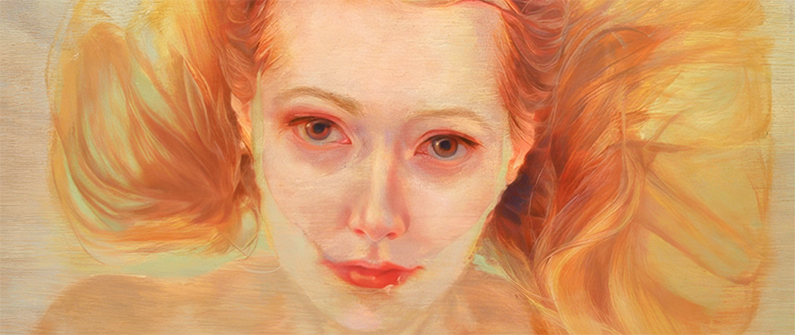
Several works focus on the observation of natural phenomena, like Elina Anatole's painting of a woman emerging from the water which captures a fleeting interaction between body and environment, recording the behavior of water as it carries strands of hair across its surface. Shawn Huckins's painting "War Cloud Behind Sheer Curtain" also originated from a naturally phenomenal encounter. Inspired by the orange glow cast across the artist's home by smoke from Canadian wildfires, the work frames an ominous atmospheric formation behind a translucent curtain, transforming an observed environmental event into an image that reflects both its physical reality and its mediated experience.
For Michael Dweck, observation becomes immersive and experiential. His four-panel "Refractions 683" and photographs "Mermaid 168, Weeki Wachee" and "Pin Up Poster 4, Montauk, NY" place the figure within water, foliage and natural light, emphasizing moments of encounter between the human body and the landscape. Cropped closely and often partially obscured, the photographs prioritize sensation and proximity over narrative, inviting viewers to consider the ways in which nature is experienced rather than simply seen.
Organic forms provide a point of departure for Silvia Poloto and Naomie Kremer. In "Bloom and Shadow I" and the "Fragrant Whisper" series, Poloto uses flowers not as descriptive subjects but as mutable forms through which to explore transformation and impermanence. Kremer's "Wing," informed by synesthetic experience, transforms sensory perception into a vibrant multisensory composition in which color, movement and form become intertwined.
Peter Gutkin's sculptures and works on paper draw upon observations of celestial phenomena. Works such as "Saturn" and "Helios V" translate planetary imagery into refined geometric forms, while "Swiss Cheese" uses light and shadow as active components of the sculpture itself, calling upon the viewer to act as the observer. His minimalist floor sculptures and atmospheric works on paper likewise reduce complex visual experiences to their essential relationships of color, form and space.
Together, the works in "Field Notes" demonstrate the many ways observation can be transformed into visual language. Whether grounded in the study of landscape, the recording of atmospheric events, the examination of organic structures or the reconstruction of historical places, each work begins with sustained attention to the observable world. "Field Notes" considers how artists gather, interpret and translate information through looking, revealing observation not merely as a means of description, but as a process through which experience becomes image, object and form.
THE PUBLIC IS INVITED TO AN OPENING RECEPTION FOR THE ARTISTS ON WEDNESDAY, JULY 8, FROM 6:00-8:00PM
show less
OPENING RECEPTION WEDNESDAY, JULY 8, 6-8PM
Modernism is pleased to present "Field Notes," a group exhibition featuring works by Elina Anatole, Michael Dweck, Damian Elwes, Peter Gutkin, Shawn Huckins, Naomie Kremer, Silvia Poloto, Victor Reyes and Sam Tchakalian.
"Field Notes" brings together nine gallery artists whose work is rooted in the act of observation. Across painting, sculpture, photography and works on paper, the exhibition presents varied responses to encounters with place, natural phenomena and organic forms. Together, these works reflect the enduring practice of looking closely at the world and translating observation into visual expression.
The term "field notes" most commonly refers to documentation made in real-time in the field. Naturalists, explorers and researchers have long relied on them to document observations, phenomena and encounters with the world around them. The journals of Alexander von Humboldt [1769-1859], which combined scientific observation with detailed descriptions of landscape, helped establish a model for understanding the natural world through attentive looking. Though working across diverse mediums and subjects, the artists in "Field Notes" share a similar commitment to observation as a starting point for artistic inquiry.
Damian Elwes' painting of Pablo Picasso's studio at Rue de la Boétie exemplifies observation translated through research and reconstruction. Drawing upon photographs, archival materials, literary sources and site visits, Elwes meticulously reimagines historic artist studios that no longer exist, transforming accumulated evidence into richly detailed paintings. Sam Tchakalian's [1929-2004] "Gold Rush" similarly distills a landscape of the past into visual form. Built through dense fields of color and impasto, the painting evokes the atmosphere and sensation of place rather than its literal appearance. Victor Reyes's large-scale geometric painting reflects a different mode of observation. Emerging from decades spent absorbing the visual language of urban space--from graffiti, typography and murals to the rhythms of the built environment--Reyes translates the accumulated impressions of city life into a dynamic arrangement of intersecting forms, layered color and spatial tension.
Several works focus on the observation of natural phenomena, like Elina Anatole's painting of a woman emerging from the water which captures a fleeting interaction between body and environment, recording the behavior of water as it carries strands of hair across its surface. Shawn Huckins's painting "War Cloud Behind Sheer Curtain" also originated from a naturally phenomenal encounter. Inspired by the orange glow cast across the artist's home by smoke from Canadian wildfires, the work frames an ominous atmospheric formation behind a translucent curtain, transforming an observed environmental event into an image that reflects both its physical reality and its mediated experience.
For Michael Dweck, observation becomes immersive and experiential. His four-panel "Refractions 683" and photographs "Mermaid 168, Weeki Wachee" and "Pin Up Poster 4, Montauk, NY" place the figure within water, foliage and natural light, emphasizing moments of encounter between the human body and the landscape. Cropped closely and often partially obscured, the photographs prioritize sensation and proximity over narrative, inviting viewers to consider the ways in which nature is experienced rather than simply seen.
Organic forms provide a point of departure for Silvia Poloto and Naomie Kremer. In "Bloom and Shadow I" and the "Fragrant Whisper" series, Poloto uses flowers not as descriptive subjects but as mutable forms through which to explore transformation and impermanence. Kremer's "Wing," informed by synesthetic experience, transforms sensory perception into a vibrant multisensory composition in which color, movement and form become intertwined.
Peter Gutkin's sculptures and works on paper draw upon observations of celestial phenomena. Works such as "Saturn" and "Helios V" translate planetary imagery into refined geometric forms, while "Swiss Cheese" uses light and shadow as active components of the sculpture itself, calling upon the viewer to act as the observer. His minimalist floor sculptures and atmospheric works on paper likewise reduce complex visual experiences to their essential relationships of color, form and space.
Together, the works in "Field Notes" demonstrate the many ways observation can be transformed into visual language. Whether grounded in the study of landscape, the recording of atmospheric events, the examination of organic structures or the reconstruction of historical places, each work begins with sustained attention to the observable world. "Field Notes" considers how artists gather, interpret and translate information through looking, revealing observation not merely as a means of description, but as a process through which experience becomes image, object and form.
THE PUBLIC IS INVITED TO AN OPENING RECEPTION FOR THE ARTISTS ON WEDNESDAY, JULY 8, FROM 6:00-8:00PM
ON VIEW JULY 8 - AUGUST 29, 2026
OPENING RECEPTION WEDNESDAY, JULY 8, 6-8PM
Modernism is pleased to present "Field Notes," a group exhibition featuring works by Elina Anatole, Michael Dweck, Damian Elwes, Peter Gutkin, Shawn Huckins, Naomie Kremer, Silvia Poloto, Victor Reyes and Sam Tchakalian.
"Field Notes" brings together nine gallery artists whose work is rooted in the act of observation. Across painting, sculpture, photography and works on paper, the exhibition presents varied responses to encounters with place, natural phenomena and organic forms. Together, these works reflect the enduring practice of looking closely at the world and translating observation into visual expression.
The term "field notes" most commonly refers to documentation made in real-time in the field. Naturalists, explorers and researchers have long relied on them to document observations, phenomena and encounters with the world around them. The journals of Alexander von Humboldt [1769-1859], which combined scientific observation with detailed descriptions of landscape, helped establish a model for understanding the natural world through attentive looking. Though working across diverse mediums and subjects, the artists in "Field Notes" share a similar commitment to observation as a starting point for artistic inquiry.
Damian Elwes' painting of Pablo Picasso's studio at Rue de la Boétie exemplifies observation translated through research and reconstruction. Drawing upon photographs, archival materials, literary sources and site visits, Elwes meticulously reimagines historic artist studios that no longer exist, transforming accumulated evidence into richly detailed paintings. Sam Tchakalian's [1929-2004] "Gold Rush" similarly distills a landscape of the past into visual form. Built through dense fields of color and impasto, the painting evokes the atmosphere and sensation of place rather than its literal appearance. Victor Reyes's large-scale geometric painting reflects a different mode of observation. Emerging from decades spent absorbing the visual language of urban space--from graffiti, typography and murals to the rhythms of the built environment--Reyes translates the accumulated impressions of city life into a dynamic arrangement of intersecting forms, layered color and spatial tension.
Several works focus on the observation of natural phenomena, like Elina Anatole's painting of a woman emerging from the water which captures a fleeting interaction between body and environment, recording the behavior of water as it carries strands of hair across its surface. Shawn Huckins's painting "War Cloud Behind Sheer Curtain" also originated from a naturally phenomenal encounter. Inspired by the orange glow cast across the artist's home by smoke from Canadian wildfires, the work frames an ominous atmospheric formation behind a translucent curtain, transforming an observed environmental event into an image that reflects both its physical reality and its mediated experience.
For Michael Dweck, observation becomes immersive and experiential. His four-panel "Refractions 683" and photographs "Mermaid 168, Weeki Wachee" and "Pin Up Poster 4, Montauk, NY" place the figure within water, foliage and natural light, emphasizing moments of encounter between the human body and the landscape. Cropped closely and often partially obscured, the photographs prioritize sensation and proximity over narrative, inviting viewers to consider the ways in which nature is experienced rather than simply seen.
Organic forms provide a point of departure for Silvia Poloto and Naomie Kremer. In "Bloom and Shadow I" and the "Fragrant Whisper" series, Poloto uses flowers not as descriptive subjects but as mutable forms through which to explore transformation and impermanence. Kremer's "Wing," informed by synesthetic experience, transforms sensory perception into a vibrant multisensory composition in which color, movement and form become intertwined.
Peter Gutkin's sculptures and works on paper draw upon observations of celestial phenomena. Works such as "Saturn" and "Helios V" translate planetary imagery into refined geometric forms, while "Swiss Cheese" uses light and shadow as active components of the sculpture itself, calling upon the viewer to act as the observer. His minimalist floor sculptures and atmospheric works on paper likewise reduce complex visual experiences to their essential relationships of color, form and space.
Together, the works in "Field Notes" demonstrate the many ways observation can be transformed into visual language. Whether grounded in the study of landscape, the recording of atmospheric events, the examination of organic structures or the reconstruction of historical places, each work begins with sustained attention to the observable world. "Field Notes" considers how artists gather, interpret and translate information through looking, revealing observation not merely as a means of description, but as a process through which experience becomes image, object and form.
THE PUBLIC IS INVITED TO AN OPENING RECEPTION FOR THE ARTISTS ON WEDNESDAY, JULY 8, FROM 6:00-8:00PM
read more
OPENING RECEPTION WEDNESDAY, JULY 8, 6-8PM
Modernism is pleased to present "Field Notes," a group exhibition featuring works by Elina Anatole, Michael Dweck, Damian Elwes, Peter Gutkin, Shawn Huckins, Naomie Kremer, Silvia Poloto, Victor Reyes and Sam Tchakalian.
"Field Notes" brings together nine gallery artists whose work is rooted in the act of observation. Across painting, sculpture, photography and works on paper, the exhibition presents varied responses to encounters with place, natural phenomena and organic forms. Together, these works reflect the enduring practice of looking closely at the world and translating observation into visual expression.
The term "field notes" most commonly refers to documentation made in real-time in the field. Naturalists, explorers and researchers have long relied on them to document observations, phenomena and encounters with the world around them. The journals of Alexander von Humboldt [1769-1859], which combined scientific observation with detailed descriptions of landscape, helped establish a model for understanding the natural world through attentive looking. Though working across diverse mediums and subjects, the artists in "Field Notes" share a similar commitment to observation as a starting point for artistic inquiry.
Damian Elwes' painting of Pablo Picasso's studio at Rue de la Boétie exemplifies observation translated through research and reconstruction. Drawing upon photographs, archival materials, literary sources and site visits, Elwes meticulously reimagines historic artist studios that no longer exist, transforming accumulated evidence into richly detailed paintings. Sam Tchakalian's [1929-2004] "Gold Rush" similarly distills a landscape of the past into visual form. Built through dense fields of color and impasto, the painting evokes the atmosphere and sensation of place rather than its literal appearance. Victor Reyes's large-scale geometric painting reflects a different mode of observation. Emerging from decades spent absorbing the visual language of urban space--from graffiti, typography and murals to the rhythms of the built environment--Reyes translates the accumulated impressions of city life into a dynamic arrangement of intersecting forms, layered color and spatial tension.
Several works focus on the observation of natural phenomena, like Elina Anatole's painting of a woman emerging from the water which captures a fleeting interaction between body and environment, recording the behavior of water as it carries strands of hair across its surface. Shawn Huckins's painting "War Cloud Behind Sheer Curtain" also originated from a naturally phenomenal encounter. Inspired by the orange glow cast across the artist's home by smoke from Canadian wildfires, the work frames an ominous atmospheric formation behind a translucent curtain, transforming an observed environmental event into an image that reflects both its physical reality and its mediated experience.
For Michael Dweck, observation becomes immersive and experiential. His four-panel "Refractions 683" and photographs "Mermaid 168, Weeki Wachee" and "Pin Up Poster 4, Montauk, NY" place the figure within water, foliage and natural light, emphasizing moments of encounter between the human body and the landscape. Cropped closely and often partially obscured, the photographs prioritize sensation and proximity over narrative, inviting viewers to consider the ways in which nature is experienced rather than simply seen.
Organic forms provide a point of departure for Silvia Poloto and Naomie Kremer. In "Bloom and Shadow I" and the "Fragrant Whisper" series, Poloto uses flowers not as descriptive subjects but as mutable forms through which to explore transformation and impermanence. Kremer's "Wing," informed by synesthetic experience, transforms sensory perception into a vibrant multisensory composition in which color, movement and form become intertwined.
Peter Gutkin's sculptures and works on paper draw upon observations of celestial phenomena. Works such as "Saturn" and "Helios V" translate planetary imagery into refined geometric forms, while "Swiss Cheese" uses light and shadow as active components of the sculpture itself, calling upon the viewer to act as the observer. His minimalist floor sculptures and atmospheric works on paper likewise reduce complex visual experiences to their essential relationships of color, form and space.
Together, the works in "Field Notes" demonstrate the many ways observation can be transformed into visual language. Whether grounded in the study of landscape, the recording of atmospheric events, the examination of organic structures or the reconstruction of historical places, each work begins with sustained attention to the observable world. "Field Notes" considers how artists gather, interpret and translate information through looking, revealing observation not merely as a means of description, but as a process through which experience becomes image, object and form.
THE PUBLIC IS INVITED TO AN OPENING RECEPTION FOR THE ARTISTS ON WEDNESDAY, JULY 8, FROM 6:00-8:00PM
show less
Date/Times:
The Best Events
Every Week in Your Inbox

From Our Sponsors
UPCOMING EVENTS




Great suggestion! We'll be in touch.
Event reviewed successfully.