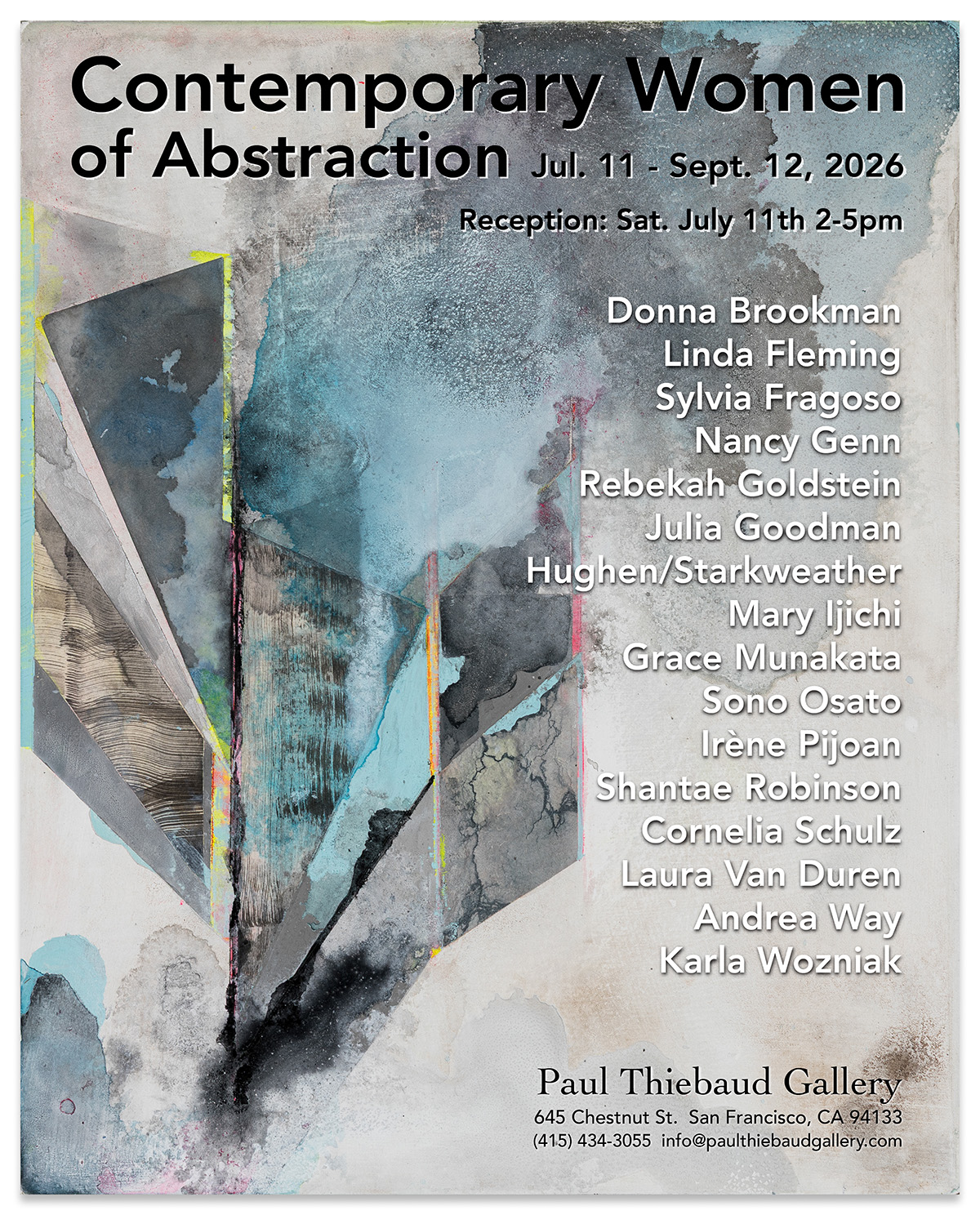
Contemporary Women of Abstraction
July 11 - September 12, 2026
Opening reception: Saturday, July 11th from 2 to 5 pm
Remarks: 2:30pm
Paul Thiebaud Gallery is pleased to announce the opening of Contemporary Women of Abstraction, an exhibition featuring 16 artists who either work in or have ties to the Bay Area, on Saturday, July 11, 2026, from 2-5pm, with remarks at 2:30pm. On view will be paintings, sculpture, and ceramics by Donna Brookman, Linda Fleming, Sylvia Fragoso, Nancy Genn, Rebekah Goldstein, Julia Goodman, Hughen/Starkweather, Mary Ijichi, Grace Munakata, Sono Osato, Irène Pijoan, Shantae Robinson, Cornelia Schulz, Laura Van Duren, Andrea Way, and Karla Wozniak. Featuring three generations of female artists, including two from the NIAD center for artists with disabilities, the exhibition reveals not only each artist's investigations of abstraction, but also conceptual and visual throughlines bridging generations. The exhibition will be on view through September 12, 2026.
In the years after World War II, Abstract Expressionism exploded out of New York's Downtown art scene and its impact can still be felt today. While the cultural zeitgeist that produced the AbEx movement has entered the annals of history, the visual language it brought forth in painting has since been adapted and combined with new sources of inspiration by successive generations of artists. Two of these sources are the environment/climate change and our relationship to the land. The paintings on paper and panel by the artist collaboration Hughen/Starkweather are heavily informed by their research practice into the impacts of climate disruption on places where water, land, and humans interact in the landscape. Grace Munakata's paintings and collages also draw upon the natural landscape and environmental concerns, visually mixing passages of abstract brushstrokes with recognizable images of animals and Japanese textile patterns from her childhood. Donna Brookman's 'fullflood' oil paintings capture the impression of water flowing across the land in evocative, thickly painted strokes, creating sublime meditations on our relationship to terra firma. Sono Osato's paintings and pastels on paper employ abstraction as a tool to interrogate the landscape as an archeological site for investigating the origins of technology and language.
One of the evolutionary paths American abstract painting took in the 1960s was the inclusion of linear and/or geometric structures as a strategy for creating compositions. Cornelia Schulz's paintings juxtapose heavily impastoed topographies of oil paint against geometrically shaped canvases to create a visual tension between form and structure. Loosely inspired by the Lycian cliff tombs in Turkey and ancient architectural interiors, Nancy Genn's paintings combine collaged paper with subtly modulated tonalities to produce resonate works. Linda Fleming's large-scale pastel drawings and lace-like, laser-cut steel and wood sculptures are meditations on the metaphysics of geometric forms that utilize volume, line and color to generate optical effects in the viewer's eye.
Pattern and patterning entered into American abstraction in the late 1960s with the incorporation of minimalist and conceptual principles into painting. One avenue for its arrival was through the creation of "rule based drawing", where a set of instructions determines what a drawing or painting will look like. For over four decades, Andrea Way has used rules to guide her as she layers patterns from nature one atop another to form intricate networks in her drawings and screenprints. Obsessive mark making was another avenue through which patterning emerged. Mary Ijichi's serene 'Assemblage' drawing constructions are formed through the precise layering of materials and intense attention to detail found in her colored pencil rubbings on their mylar surfaces. The late Irène Pijoan's (1953-2004) delicately poetic mixed media and cut paper works were deeply inspired by her Buddhist meditation practice and emphasize the importance of form, void, and shadow within her work.
The body, motherhood, and the Feminist perspective have also been sources of inspiration for women abstract artists. Laura Van Duren's mixed media ceramic sculptures fuse materials such as wood, vinyl, rubber, glycerin, and thread with organically shaped clay forms to create fetish like objects that evoke the visceral and the abject. Karla Wozniak's brightly colored oil and acrylic canvases are a synthesis of the thoughts and ideas from her everyday life, which in recent years have included visual motifs of the toys and games her young daughter enjoys playing. Julia Goodman's sculptural reliefs in cast handmade paper explore the intersection of astronomical cycles of deep and personal time with the unacknowledged labor women perform raising children and caregiving to family members. Rebekah Goldstein's shaped canvas oil paintings incorporate architectural flourishes, furniture, textiles, art history, and the abstracted human form as visual influences as she works and reworks her surfaces to reveal the final compositions.
The San Francisco Bay Area is home to three important creative centers that support artists with disabilities. The artists working at these centers think, perceive, and work differently, often creating unique and highly original artistic expressions. Two artists from the NIAD center included in the exhibition are Sylvia Fragoso and Shantae Robinson. Sylvia Fragoso's brightly colored ceramic constructions draw deeply on the architecture of spiritual spaces she has visited and her grandmother's past home in Mexico. Shante Robinson's abstract paintings and ceramics incorporate repeated shapes and marks, such as the orb, spiral, and her signature 'S', to form patchworks of vivid colors that draw the eye across her compositions.
While in no way a comprehensive exploration of the possibilities abstraction has to offer, the 16 female artists in Contemporary Women of Abstraction simultaneously explore unique aesthetic territories, while also drawing on similar visual and thematic sources of inspiration, resulting in rigorous, sublime, intuitive, and timely works engaged with the broader cultural moment.
show less
July 11 - September 12, 2026
Opening reception: Saturday, July 11th from 2 to 5 pm
Remarks: 2:30pm
Paul Thiebaud Gallery is pleased to announce the opening of Contemporary Women of Abstraction, an exhibition featuring 16 artists who either work in or have ties to the Bay Area, on Saturday, July 11, 2026, from 2-5pm, with remarks at 2:30pm. On view will be paintings, sculpture, and ceramics by Donna Brookman, Linda Fleming, Sylvia Fragoso, Nancy Genn, Rebekah Goldstein, Julia Goodman, Hughen/Starkweather, Mary Ijichi, Grace Munakata, Sono Osato, Irène Pijoan, Shantae Robinson, Cornelia Schulz, Laura Van Duren, Andrea Way, and Karla Wozniak. Featuring three generations of female artists, including two from the NIAD center for artists with disabilities, the exhibition reveals not only each artist's investigations of abstraction, but also conceptual and visual throughlines bridging generations. The exhibition will be on view through September 12, 2026.
In the years after World War II, Abstract Expressionism exploded out of New York's Downtown art scene and its impact can still be felt today. While the cultural zeitgeist that produced the AbEx movement has entered the annals of history, the visual language it brought forth in painting has since been adapted and combined with new sources of inspiration by successive generations of artists. Two of these sources are the environment/climate change and our relationship to the land. The paintings on paper and panel by the artist collaboration Hughen/Starkweather are heavily informed by their research practice into the impacts of climate disruption on places where water, land, and humans interact in the landscape. Grace Munakata's paintings and collages also draw upon the natural landscape and environmental concerns, visually mixing passages of abstract brushstrokes with recognizable images of animals and Japanese textile patterns from her childhood. Donna Brookman's 'fullflood' oil paintings capture the impression of water flowing across the land in evocative, thickly painted strokes, creating sublime meditations on our relationship to terra firma. Sono Osato's paintings and pastels on paper employ abstraction as a tool to interrogate the landscape as an archeological site for investigating the origins of technology and language.
One of the evolutionary paths American abstract painting took in the 1960s was the inclusion of linear and/or geometric structures as a strategy for creating compositions. Cornelia Schulz's paintings juxtapose heavily impastoed topographies of oil paint against geometrically shaped canvases to create a visual tension between form and structure. Loosely inspired by the Lycian cliff tombs in Turkey and ancient architectural interiors, Nancy Genn's paintings combine collaged paper with subtly modulated tonalities to produce resonate works. Linda Fleming's large-scale pastel drawings and lace-like, laser-cut steel and wood sculptures are meditations on the metaphysics of geometric forms that utilize volume, line and color to generate optical effects in the viewer's eye.
Pattern and patterning entered into American abstraction in the late 1960s with the incorporation of minimalist and conceptual principles into painting. One avenue for its arrival was through the creation of "rule based drawing", where a set of instructions determines what a drawing or painting will look like. For over four decades, Andrea Way has used rules to guide her as she layers patterns from nature one atop another to form intricate networks in her drawings and screenprints. Obsessive mark making was another avenue through which patterning emerged. Mary Ijichi's serene 'Assemblage' drawing constructions are formed through the precise layering of materials and intense attention to detail found in her colored pencil rubbings on their mylar surfaces. The late Irène Pijoan's (1953-2004) delicately poetic mixed media and cut paper works were deeply inspired by her Buddhist meditation practice and emphasize the importance of form, void, and shadow within her work.
The body, motherhood, and the Feminist perspective have also been sources of inspiration for women abstract artists. Laura Van Duren's mixed media ceramic sculptures fuse materials such as wood, vinyl, rubber, glycerin, and thread with organically shaped clay forms to create fetish like objects that evoke the visceral and the abject. Karla Wozniak's brightly colored oil and acrylic canvases are a synthesis of the thoughts and ideas from her everyday life, which in recent years have included visual motifs of the toys and games her young daughter enjoys playing. Julia Goodman's sculptural reliefs in cast handmade paper explore the intersection of astronomical cycles of deep and personal time with the unacknowledged labor women perform raising children and caregiving to family members. Rebekah Goldstein's shaped canvas oil paintings incorporate architectural flourishes, furniture, textiles, art history, and the abstracted human form as visual influences as she works and reworks her surfaces to reveal the final compositions.
The San Francisco Bay Area is home to three important creative centers that support artists with disabilities. The artists working at these centers think, perceive, and work differently, often creating unique and highly original artistic expressions. Two artists from the NIAD center included in the exhibition are Sylvia Fragoso and Shantae Robinson. Sylvia Fragoso's brightly colored ceramic constructions draw deeply on the architecture of spiritual spaces she has visited and her grandmother's past home in Mexico. Shante Robinson's abstract paintings and ceramics incorporate repeated shapes and marks, such as the orb, spiral, and her signature 'S', to form patchworks of vivid colors that draw the eye across her compositions.
While in no way a comprehensive exploration of the possibilities abstraction has to offer, the 16 female artists in Contemporary Women of Abstraction simultaneously explore unique aesthetic territories, while also drawing on similar visual and thematic sources of inspiration, resulting in rigorous, sublime, intuitive, and timely works engaged with the broader cultural moment.
Contemporary Women of Abstraction
July 11 - September 12, 2026
Opening reception: Saturday, July 11th from 2 to 5 pm
Remarks: 2:30pm
Paul Thiebaud Gallery is pleased to announce the opening of Contemporary Women of Abstraction, an exhibition featuring 16 artists who either work in or have ties to the Bay Area, on Saturday, July 11, 2026, from 2-5pm, with remarks at 2:30pm. On view will be paintings, sculpture, and ceramics by Donna Brookman, Linda Fleming, Sylvia Fragoso, Nancy Genn, Rebekah Goldstein, Julia Goodman, Hughen/Starkweather, Mary Ijichi, Grace Munakata, Sono Osato, Irène Pijoan, Shantae Robinson, Cornelia Schulz, Laura Van Duren, Andrea Way, and Karla Wozniak. Featuring three generations of female artists, including two from the NIAD center for artists with disabilities, the exhibition reveals not only each artist's investigations of abstraction, but also conceptual and visual throughlines bridging generations. The exhibition will be on view through September 12, 2026.
In the years after World War II, Abstract Expressionism exploded out of New York's Downtown art scene and its impact can still be felt today. While the cultural zeitgeist that produced the AbEx movement has entered the annals of history, the visual language it brought forth in painting has since been adapted and combined with new sources of inspiration by successive generations of artists. Two of these sources are the environment/climate change and our relationship to the land. The paintings on paper and panel by the artist collaboration Hughen/Starkweather are heavily informed by their research practice into the impacts of climate disruption on places where water, land, and humans interact in the landscape. Grace Munakata's paintings and collages also draw upon the natural landscape and environmental concerns, visually mixing passages of abstract brushstrokes with recognizable images of animals and Japanese textile patterns from her childhood. Donna Brookman's 'fullflood' oil paintings capture the impression of water flowing across the land in evocative, thickly painted strokes, creating sublime meditations on our relationship to terra firma. Sono Osato's paintings and pastels on paper employ abstraction as a tool to interrogate the landscape as an archeological site for investigating the origins of technology and language.
One of the evolutionary paths American abstract painting took in the 1960s was the inclusion of linear and/or geometric structures as a strategy for creating compositions. Cornelia Schulz's paintings juxtapose heavily impastoed topographies of oil paint against geometrically shaped canvases to create a visual tension between form and structure. Loosely inspired by the Lycian cliff tombs in Turkey and ancient architectural interiors, Nancy Genn's paintings combine collaged paper with subtly modulated tonalities to produce resonate works. Linda Fleming's large-scale pastel drawings and lace-like, laser-cut steel and wood sculptures are meditations on the metaphysics of geometric forms that utilize volume, line and color to generate optical effects in the viewer's eye.
Pattern and patterning entered into American abstraction in the late 1960s with the incorporation of minimalist and conceptual principles into painting. One avenue for its arrival was through the creation of "rule based drawing", where a set of instructions determines what a drawing or painting will look like. For over four decades, Andrea Way has used rules to guide her as she layers patterns from nature one atop another to form intricate networks in her drawings and screenprints. Obsessive mark making was another avenue through which patterning emerged. Mary Ijichi's serene 'Assemblage' drawing constructions are formed through the precise layering of materials and intense attention to detail found in her colored pencil rubbings on their mylar surfaces. The late Irène Pijoan's (1953-2004) delicately poetic mixed media and cut paper works were deeply inspired by her Buddhist meditation practice and emphasize the importance of form, void, and shadow within her work.
The body, motherhood, and the Feminist perspective have also been sources of inspiration for women abstract artists. Laura Van Duren's mixed media ceramic sculptures fuse materials such as wood, vinyl, rubber, glycerin, and thread with organically shaped clay forms to create fetish like objects that evoke the visceral and the abject. Karla Wozniak's brightly colored oil and acrylic canvases are a synthesis of the thoughts and ideas from her everyday life, which in recent years have included visual motifs of the toys and games her young daughter enjoys playing. Julia Goodman's sculptural reliefs in cast handmade paper explore the intersection of astronomical cycles of deep and personal time with the unacknowledged labor women perform raising children and caregiving to family members. Rebekah Goldstein's shaped canvas oil paintings incorporate architectural flourishes, furniture, textiles, art history, and the abstracted human form as visual influences as she works and reworks her surfaces to reveal the final compositions.
The San Francisco Bay Area is home to three important creative centers that support artists with disabilities. The artists working at these centers think, perceive, and work differently, often creating unique and highly original artistic expressions. Two artists from the NIAD center included in the exhibition are Sylvia Fragoso and Shantae Robinson. Sylvia Fragoso's brightly colored ceramic constructions draw deeply on the architecture of spiritual spaces she has visited and her grandmother's past home in Mexico. Shante Robinson's abstract paintings and ceramics incorporate repeated shapes and marks, such as the orb, spiral, and her signature 'S', to form patchworks of vivid colors that draw the eye across her compositions.
While in no way a comprehensive exploration of the possibilities abstraction has to offer, the 16 female artists in Contemporary Women of Abstraction simultaneously explore unique aesthetic territories, while also drawing on similar visual and thematic sources of inspiration, resulting in rigorous, sublime, intuitive, and timely works engaged with the broader cultural moment.
read more
July 11 - September 12, 2026
Opening reception: Saturday, July 11th from 2 to 5 pm
Remarks: 2:30pm
Paul Thiebaud Gallery is pleased to announce the opening of Contemporary Women of Abstraction, an exhibition featuring 16 artists who either work in or have ties to the Bay Area, on Saturday, July 11, 2026, from 2-5pm, with remarks at 2:30pm. On view will be paintings, sculpture, and ceramics by Donna Brookman, Linda Fleming, Sylvia Fragoso, Nancy Genn, Rebekah Goldstein, Julia Goodman, Hughen/Starkweather, Mary Ijichi, Grace Munakata, Sono Osato, Irène Pijoan, Shantae Robinson, Cornelia Schulz, Laura Van Duren, Andrea Way, and Karla Wozniak. Featuring three generations of female artists, including two from the NIAD center for artists with disabilities, the exhibition reveals not only each artist's investigations of abstraction, but also conceptual and visual throughlines bridging generations. The exhibition will be on view through September 12, 2026.
In the years after World War II, Abstract Expressionism exploded out of New York's Downtown art scene and its impact can still be felt today. While the cultural zeitgeist that produced the AbEx movement has entered the annals of history, the visual language it brought forth in painting has since been adapted and combined with new sources of inspiration by successive generations of artists. Two of these sources are the environment/climate change and our relationship to the land. The paintings on paper and panel by the artist collaboration Hughen/Starkweather are heavily informed by their research practice into the impacts of climate disruption on places where water, land, and humans interact in the landscape. Grace Munakata's paintings and collages also draw upon the natural landscape and environmental concerns, visually mixing passages of abstract brushstrokes with recognizable images of animals and Japanese textile patterns from her childhood. Donna Brookman's 'fullflood' oil paintings capture the impression of water flowing across the land in evocative, thickly painted strokes, creating sublime meditations on our relationship to terra firma. Sono Osato's paintings and pastels on paper employ abstraction as a tool to interrogate the landscape as an archeological site for investigating the origins of technology and language.
One of the evolutionary paths American abstract painting took in the 1960s was the inclusion of linear and/or geometric structures as a strategy for creating compositions. Cornelia Schulz's paintings juxtapose heavily impastoed topographies of oil paint against geometrically shaped canvases to create a visual tension between form and structure. Loosely inspired by the Lycian cliff tombs in Turkey and ancient architectural interiors, Nancy Genn's paintings combine collaged paper with subtly modulated tonalities to produce resonate works. Linda Fleming's large-scale pastel drawings and lace-like, laser-cut steel and wood sculptures are meditations on the metaphysics of geometric forms that utilize volume, line and color to generate optical effects in the viewer's eye.
Pattern and patterning entered into American abstraction in the late 1960s with the incorporation of minimalist and conceptual principles into painting. One avenue for its arrival was through the creation of "rule based drawing", where a set of instructions determines what a drawing or painting will look like. For over four decades, Andrea Way has used rules to guide her as she layers patterns from nature one atop another to form intricate networks in her drawings and screenprints. Obsessive mark making was another avenue through which patterning emerged. Mary Ijichi's serene 'Assemblage' drawing constructions are formed through the precise layering of materials and intense attention to detail found in her colored pencil rubbings on their mylar surfaces. The late Irène Pijoan's (1953-2004) delicately poetic mixed media and cut paper works were deeply inspired by her Buddhist meditation practice and emphasize the importance of form, void, and shadow within her work.
The body, motherhood, and the Feminist perspective have also been sources of inspiration for women abstract artists. Laura Van Duren's mixed media ceramic sculptures fuse materials such as wood, vinyl, rubber, glycerin, and thread with organically shaped clay forms to create fetish like objects that evoke the visceral and the abject. Karla Wozniak's brightly colored oil and acrylic canvases are a synthesis of the thoughts and ideas from her everyday life, which in recent years have included visual motifs of the toys and games her young daughter enjoys playing. Julia Goodman's sculptural reliefs in cast handmade paper explore the intersection of astronomical cycles of deep and personal time with the unacknowledged labor women perform raising children and caregiving to family members. Rebekah Goldstein's shaped canvas oil paintings incorporate architectural flourishes, furniture, textiles, art history, and the abstracted human form as visual influences as she works and reworks her surfaces to reveal the final compositions.
The San Francisco Bay Area is home to three important creative centers that support artists with disabilities. The artists working at these centers think, perceive, and work differently, often creating unique and highly original artistic expressions. Two artists from the NIAD center included in the exhibition are Sylvia Fragoso and Shantae Robinson. Sylvia Fragoso's brightly colored ceramic constructions draw deeply on the architecture of spiritual spaces she has visited and her grandmother's past home in Mexico. Shante Robinson's abstract paintings and ceramics incorporate repeated shapes and marks, such as the orb, spiral, and her signature 'S', to form patchworks of vivid colors that draw the eye across her compositions.
While in no way a comprehensive exploration of the possibilities abstraction has to offer, the 16 female artists in Contemporary Women of Abstraction simultaneously explore unique aesthetic territories, while also drawing on similar visual and thematic sources of inspiration, resulting in rigorous, sublime, intuitive, and timely works engaged with the broader cultural moment.
show less
Date/Times:
The Best Events
Every Week in Your Inbox

From Our Sponsors
UPCOMING EVENTS




Great suggestion! We'll be in touch.
Event reviewed successfully.